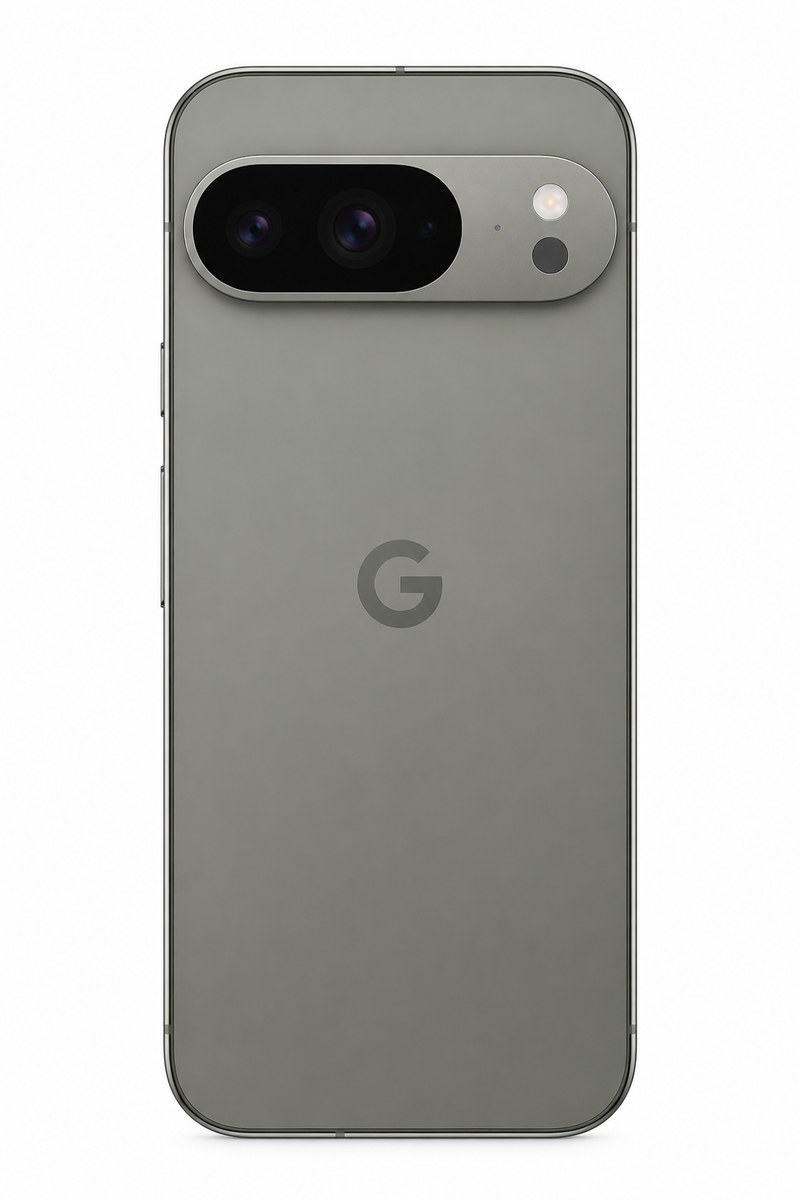
Illustrative images for identification. Not official manufacturer store photos. AllMobileSpecs is not affiliated with Google.
Pixel 11 Pro Fold
$1,899.00
Indicative USD (or converted display amount). Not a sale price and not an offer to buy.
Google foldable announced 12 August 2026; on sale 20 August in Google Store countries.
Overview
The Pixel 11 Pro Fold is Google's 2026 book-style foldable: an 8-inch Super Actua Flex inner display, a 6.5-inch Super Actua cover display, and a Tensor G6 with 16 GB of RAM. Google announced it on 12 August 2026 and said it hits shelves on 20 August. That is a confirmed on-sale date, not a rumor window.
Both panels are 1–120 Hz OLEDs with a 3600-nit peak. The cover uses ceramic cover glass; the inner display is ultra-thin glass over a gearless hinge. Google's own hardware page lists IP68, a 239 g weight, and folded dimensions of 155.2 × 76.0 × 10.1 mm. Unfolded it is 5.0 mm thick. Those figures are the reason the phone exists next to a Pixel 11 Pro slab: you are paying for two screens and a hinge, not for a faster chip than the Pro.
The rear camera is a 48 MP wide, 10.5 MP ultrawide with macro, and 10.8 MP 5× telephoto. Super Zoom is listed to 30×. That is not a 200 MP main sensor and it is not a 10× periscope. Google is selling processing — Magic Capture, Camera Looks, Night Sight — on sensors that fit a foldable stack. Front and inner cameras are both 10 MP.
Typical battery capacity is 4806 mAh. Wired charging is 30 W to about 50 percent in 30 minutes with a compatible PPS brick. Wireless is Qi2.2 Pixelsnap up to 25 W. Those watts are slower than Honor or Xiaomi flagships and typical of a Pixel. Android 17 ships on the device with a seven-year OS, security, and Pixel Drop window.
HiLight is an LED strip on the camera visor for glanceable alerts. It is a feature, not a second display. Storage is 256 GB, 512 GB, or 1 TB with 16 GB of RAM on every tier. There is no microSD slot. Colours are Olive and Obsidian.
Google Store lists the Fold in a named set of countries — the United States, United Kingdom, India, Australia, Japan, and other Store markets. India pricing has been published at ₹186,999. The USD figure on this page is the US starting price for 256 GB. AllMobileSpecs does not sell this phone. Images are illustrative.
Who it is for
A fit if you want a Google foldable with a confirmed August 2026 retail date, seven years of updates, and you already live in a Google Store country. Also a fit if you use the inner screen for split apps and translation more than you use a telephoto.
A poor fit if you need 100 W charging, a 200 MP sensor, or a phone that is already on a US prepaid carrier's approved list this week. Also a poor fit if you dislike folding-display repair bills — those stay specialist work.
How it compares
Against a Galaxy Z Fold of the same season, Samsung usually offers a more mature hinge accessory ecosystem and S Pen support on Ultra models. Google offers a longer stated update window and cleaner Android. Prices in the US sit in the same flagship-foldable band.
Against the Pixel 11 Pro slab, you lose pocket thickness and you gain an 8-inch inner panel. The Tensor generation is the same family. Buy the Fold for the screen, not for a different camera philosophy.
Against the Motorola Razr 60 Ultra on this site, the jobs differ: Razr is a clamshell with a large cover display; this Pixel is a wide inner tablet when open.
Specifications
Hardware as typically announced. Blank fields mean we have not entered a figure — we do not invent specs.
| Technology | GSM / HSPA / LTE / 5G |
|---|
| Announced | 2026, August |
|---|---|
| Status | Available; released 20 August 2026 |
| Dimensions | Unfolded 155.2 x 150.4 x 5.0 mm; folded 155.2 x 76.0 x 10.1 mm |
|---|---|
| Weight | 239 g |
| SIM | Nano-SIM + eSIM |
| IP rating | IP68 |
| Colors | Olive, Obsidian |
| Type | Foldable LTPO OLED, 120Hz (inner); Super Actua OLED, 120Hz (cover) |
|---|---|
| Size | 8.0 inches inner / 6.5 inches cover |
| Resolution | 2076 x 2152 inner; 1080 x 2342 cover |
| Protection | Ultra Thin Glass (inner); ceramic cover glass (outer) |
| OS | Android 17 |
|---|---|
| Chipset | Google Tensor G6 |
| CPU | Google Tensor G6 with Titan M3 |
| RAM | 16 GB |
|---|---|
| Storage | 256 GB / 512 GB / 1 TB |
| Card slot | No |
| Main | 48 MP (wide) + 10.5 MP (ultrawide, macro) + 10.8 MP (5x telephoto) |
|---|---|
| Selfie | 10 MP cover + 10 MP inner |
| Loudspeaker | Yes, stereo speakers |
|---|---|
| 3.5mm jack | No |
| WLAN | Wi-Fi 7 |
|---|---|
| Bluetooth | 6 |
| NFC | Yes |
| USB | USB Type-C 3.2 |
| Capacity | 4806 mAh (typical) |
|---|---|
| Charging | 30W wired; 25W Qi2.2 wireless |
| Sensors | Fingerprint, face unlock, accelerometer, gyro, proximity, compass, barometer |
|---|